
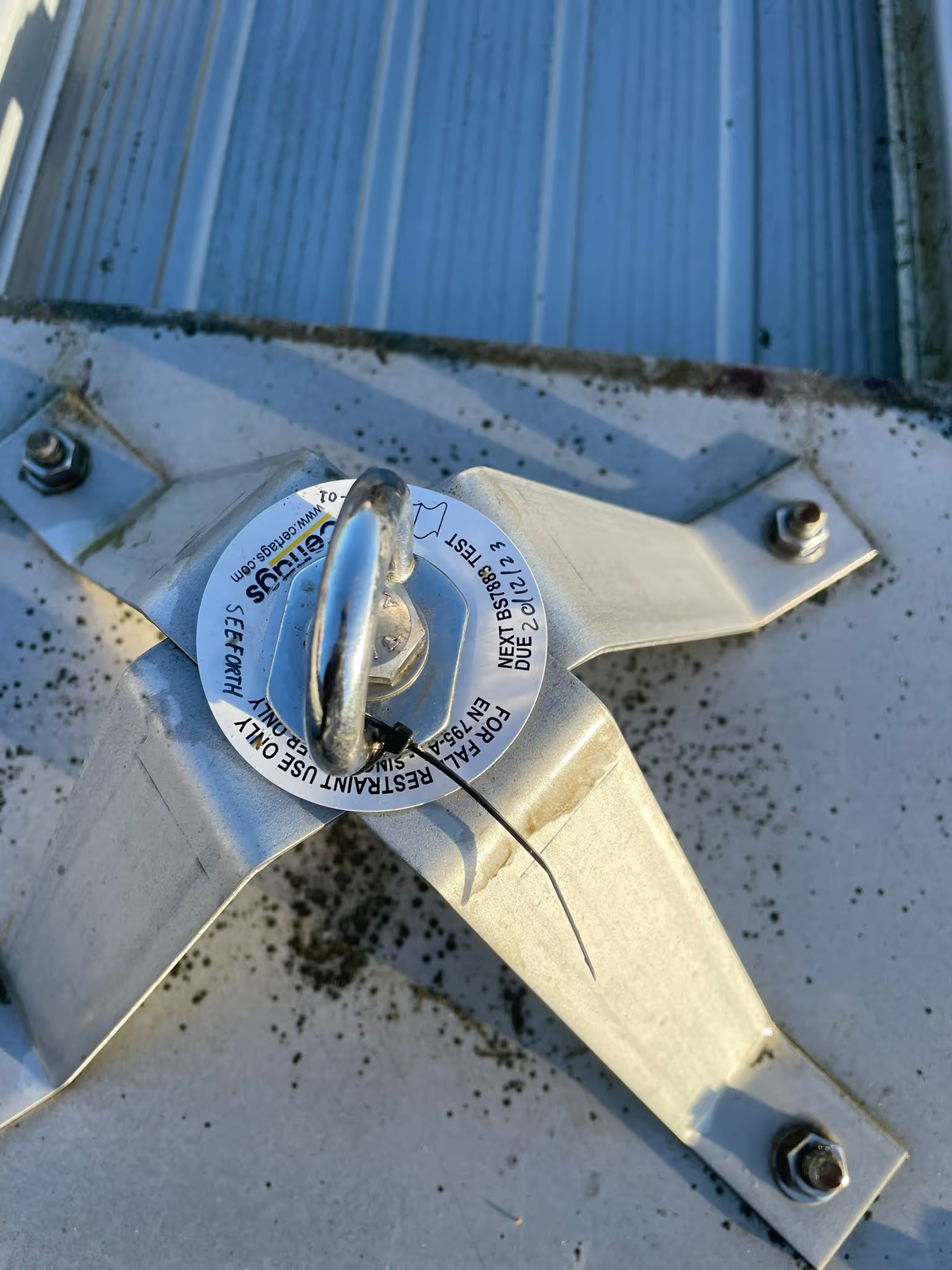
Eyebolt testing
Overview
We test and certify eyebolts and roof anchor points on commercial and residential buildings across London, Essex and Cambridge, in line with BS 7883, BS EN 795 and LOLER. Anchor points are normally tested around every 12 months, sooner where use, dam

Anchor points
Ensures anchor points can safely withstand required forces, meeting all legal and safety standards.

Certified inspection
Certified inspections ensure your anchor points meet legal safety standards and are ready for use without risk.

Anchor register
Each eyebolt is identified, tested and recorded in a register with photos, so you always know which anchor points are in date.

Ideal for high-rise
Ideal for high-rise buildings requiring safe, compliant anchor points for rope access and façade maintenance.

Eyebolt testing: the full guide
Eyebolts and roof anchors are the fixed points that rope access technicians, abseil window cleaners and anyone wearing a fall arrest harness clip on to. If one fails, someone falls. That is why anchors are tested, tagged and recorded, and why insurers and contractors ask to see the certificate before work starts.
This guide explains what an eyebolt test involves, how often anchors need testing, the standards we test to, what affects the cost, and the questions we hear most from building managers in London, Essex, Hertfordshire and Cambridge.
What we test
- Eyebolts fixed into brick, block, concrete or steel for rope access and abseil window cleaning.
- Roof anchor points used for fall arrest and fall restraint on flat roofs, including single-point anchors and the end anchors of horizontal lifeline systems.
- Internal window cleaning eyebolts fitted below windows in offices and residential blocks.
- Anchors installed by other companies, where the certificate has lapsed or the paperwork has been lost.
What the test involves
- Records check. We ask for the existing anchor register, installation records and previous certificates. Where there are none, we survey the building, number every anchor and photograph it.
- Visual inspection. Each anchor is checked for corrosion, deformation, cracks in the surrounding masonry or concrete, loose fixings and missing identification tags.
- Proof load test. Each anchor is pulled with a calibrated hydraulic tester to the load set out in BS 7883 for its type and substrate, or the load in the manufacturer's instructions. The load is held and the anchor checked for any movement.
- Tagging. Anchors that pass get a numbered tag showing the test date and the next due date. Anchors that fail are tagged as not to be used and reported to you the same day.
- Certificate and register. You receive a test certificate and an anchor register with the location, photograph, test load and result for every anchor. The register is the document your contractors and insurers will ask for.
How often eyebolts need testing
Anchor points are normally tested around every 12 months, sooner where use, damage or the manufacturer's guidance calls for it. A shorter interval makes sense in these cases.
- The anchors are used every week, for example on a building with a monthly abseil window clean.
- The building is on the coast or in an exposed position where corrosion is faster.
- An anchor has been loaded in a fall, or struck during building work nearby.
- Work has been done to the wall or roof the anchor is fixed to, such as recladding or re-roofing.
- Where an anchor forms part of a lifting operation under LOLER, your competent person may set a shorter interval.
Whatever the interval, no contractor should rig from an anchor without a certificate that is in date. Our own rope teams will not, and we check certificates before every high-rise window clean.
The standards we test to
- BS 7883:2019. The code of practice for the design, selection, installation, use and maintenance of anchor devices. It sets out what an inspection covers, the test loads and what the record must contain.
- BS EN 795:2012. The product standard for anchor devices. Type A covers fixed structural anchors such as eyebolts.
- LOLER 1998 and PUWER 1998. The regulations that require work equipment, including anchors used for lifting or fall protection, to be maintained and thoroughly examined by a competent person.
- Work at Height Regulations 2005. The duty holder must make sure equipment used for work at height is inspected and safe to use.
Our certificate records the anchor number, location, type, substrate, test load, result, the name of the tester, the test date and the next due date, which is the information BS 7883 expects to see.
What affects the price
- Number of anchors. Testing is priced per anchor, with a minimum charge per visit.
- Access. Anchors on a flat roof reached through an internal hatch cost less to test than anchors on a façade that need rope access to reach.
- Records. Where there is no register, the first visit includes surveying and numbering every anchor.
- Failures. Replacing or reinstalling a failed anchor is quoted separately once we have seen the substrate.
- Combining visits. Testing anchors on the same visit as a window clean or gutter clear saves a separate call-out.
Where we work
We test eyebolts and roof anchors across Greater London, Essex, Hertfordshire and Cambridge. Much of the work is on high-rise residential and office buildings where our own rope teams clean the windows, and for other contractors who need a current certificate before they can start.
Eyebolt testing questions
How often do eyebolts need testing?
Around every 12 months, and sooner where use, damage or the manufacturer's guidance calls for it. Heavy use, exposed locations, building work near the anchors and any fall event all justify an earlier test.
What load do you test to?
The load set out in BS 7883 for the anchor type and substrate, or the load in the manufacturer's instructions where that is higher. The load is applied with a calibrated hydraulic tester and held while the anchor is checked for movement.
What happens if an eyebolt fails?
It is tagged as not to be used and reported to you the same day, with a photograph and the reason. We can quote for replacement once we have looked at the substrate.
Do you test anchors that another company installed?
Yes. If the register and installation records are missing we survey and number the anchors first, then test and certify them.
What do I receive after the test?
A test certificate and an anchor register listing every anchor with its location, photograph, test load, result and next due date. Each anchor is tagged on site.
Can our window cleaners use the anchors before the test?
No. An anchor without a certificate in date should not be rigged from. Most rope access contractors, including our own teams, will not start work without seeing the certificate.
Do you need access inside the building?
For internal window cleaning eyebolts, yes. We need a few minutes in each room where an anchor is fitted, and we arrange this with the building manager beforehand.
Delivering high standards, safely
Meet Norbert, a seasoned IRATA Level 3 Supervisor with nearly 20 years' experience leading complex rope access operations
Norbert is an IRATA Level 3 Supervisor with nearly 20 years in rope access across Europe and the Middle East. He has led work on 75-storey buildings, iconic bridges, wind farms, oil and gas platforms and lighthouses. Calm, organised and resilient, he delivers safely on some of the world's most challenging sites.








Rated excellent for communication by a student accommodation client

"Good comms, great team."
Contact us about your property
Let us know which of our specialist cleaning or maintenance solutions you need.