
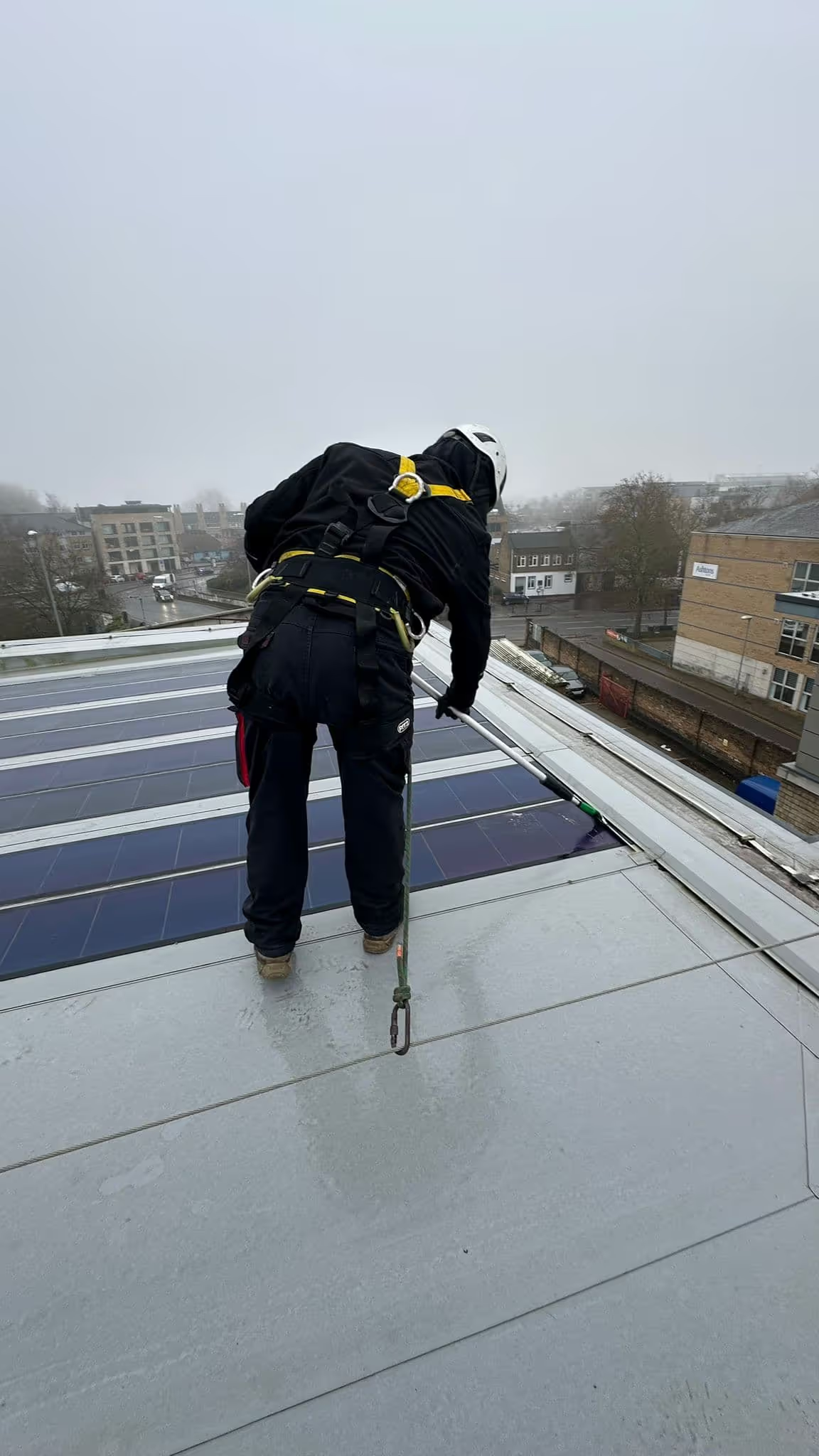
Solar panel cleaning
Overview
Our solar panel cleaning service removes dust, debris, and bird droppings using certified cleaning agents. This improves energy output, protects your investment, and ensures panels stay efficient, without harsh chemicals or damage to surfaces.

Maximise efficiency
Keeps panels performing at their best by removing dirt that blocks sunlight.

Reduce costs
Improves energy yield, helping lower your electricity bills over time.

Prevent wear and tear
Regular cleaning helps avoid long-term damage and extends panel lifespan.

Ensure warranty compliance
Maintains manufacturer standards to keep your warranty valid.
Solar panel cleaning: the full guide
A solar array only earns its keep when light reaches the cells. Traffic film, pollen, building dust, moss at the frame edge and bird droppings all sit between the sun and the glass, and on an urban roof they build up faster than most owners expect. Industry studies put the output loss on an uncleaned urban array at 15 to 20 per cent.
This guide covers how we clean commercial solar panels, how often they need it, the rules and manufacturer conditions that apply, what affects the price, and the questions we are asked most by building owners in London, Essex, Hertfordshire and Cambridge.
What the service involves
- Survey and RAMS. We check the roof type, edge protection, anchor points and the route to the array, then issue a site-specific risk assessment and method statement.
- Access. Flat roofs with edge protection are walked. Pitched roofs and arrays near an unprotected edge are reached by rope access from tested anchors or from a MEWP. Nobody stands or kneels on a panel at any point.
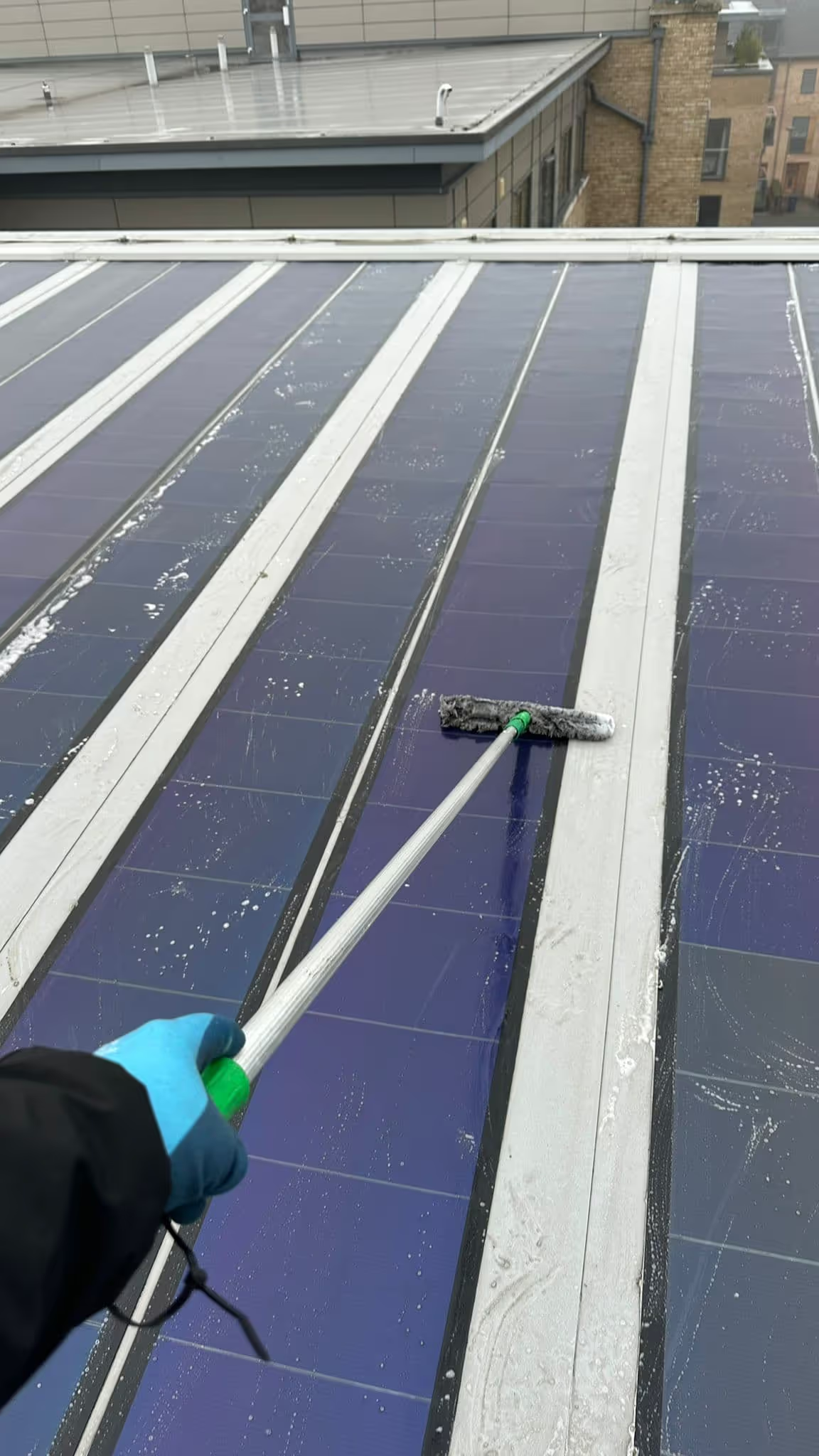
- Cleaning. Panels are washed with purified water and soft brushes on water-fed poles. Purified water dries without spots, so nothing is left on the glass to attract the next layer of dirt. We do not use detergents, abrasives or pressure washers.
- Inspection. While we are up there we look for cracked or delaminated glass, loose or chewed cabling, displaced frame clips, moss under the panel edges and birds nesting beneath the array. We do not carry out electrical work. Faults are reported to you so your installer can attend.
- Report. You receive before and after photographs of the array and a note of anything we found. Many clients keep these with their installation paperwork to show the panels have been maintained.
How often solar panels need cleaning
Twice a year is the norm for a commercial array in a town or city. Spring removes the winter grime and pollen before the strongest months of sun, and autumn clears the summer dust and bird activity before the shorter days. Some sites need more.
- Arrays near main roads, railways or building sites collect fine dust and traffic film quickly.
- Roofs under trees, or with gull and pigeon activity, need a clean whenever droppings build up. A single dropping can shade a cell for months.
- Low-pitch and flat-mounted panels do not rinse themselves in the rain the way steeply pitched panels do.
- Panels within reach of a nesting site often need bird-proofing under the array as well as cleaning.
If you have monitoring data, a steady drop in output that recovers after a clean tells you your interval is too long.
Standards, warranties and safety
- Work at Height Regulations 2005. Roof work is planned under the regulations with edge protection, anchors or a MEWP as the situation requires.
- Manufacturer's conditions. Most panel warranties require cleaning with soft methods and clean water, and exclude damage from abrasive tools, harsh chemicals or high-pressure jets. Our method stays inside those conditions, and the photo report gives you a record.
- Electrical safety. Panels generate whenever there is daylight. We treat every array as live, do not touch connectors or inverters, and stop and report if we find damaged glass or exposed cabling.
- Timing. We clean early in the day or in overcast conditions where possible, so cold water is not applied to hot glass.
What affects the price
- Number of panels. Cleaning is priced by array size, with a minimum charge per visit.
- Access. A flat roof with a guard rail and an internal hatch is quick. A pitched roof that needs rope access or a MEWP takes longer and needs more people.
- Soiling. A first clean after several years, or an array under a bird roost, takes longer than a routine six-monthly visit.
- Water. We bring purified water in the van. Very large arrays may need a second tank or a mains supply on site.
- Combining visits. Cleaning the array on the same visit as the gutters or windows saves a separate call-out.
Where we work
We clean solar panels on commercial, industrial, residential and public buildings across Greater London, Essex, Hertfordshire and Cambridge. Warehouse roofs, school and office arrays, and panels on residential blocks are typical.
Solar panel cleaning questions
How often should commercial solar panels be cleaned?
Twice a year for most urban sites, in spring and autumn. Arrays near roads, trees or bird roosts, and flat-mounted panels that rain does not rinse, often need a third visit.
Does cleaning really increase output?
Yes. Dirt on the glass shades the cells. The gain depends on how dirty the array was, and monitoring data before and after a clean will show it. Industry studies put the loss on an uncleaned urban array at 15 to 20 per cent.
Do you use chemicals?
No. We use purified water and soft brushes. Detergents leave a film, abrasives scratch the anti-reflective coating and pressure washers can force water past the seals. All three can void a warranty.
Will cleaning affect my panel warranty?
Cleaning with soft brushes and clean water is what most manufacturers ask for. Our photo report gives you a dated record that the panels have been maintained the right way.
Do you walk on the panels?
No. Panels are cleaned from the roof surface, from a rope or from a platform. Standing on a panel can crack cells that are invisible from the outside.
Can you clean panels on a pitched roof?
Yes. Pitched roofs are reached by rope access from tested anchors or from a MEWP, which means no scaffolding and usually a single day on site.
Do you check the panels for damage?
We look for cracked glass, loose cabling, displaced clips and nesting birds and report what we find with photographs. We do not carry out electrical repairs. Your installer or an electrician does that.
What about birds nesting under the panels?
Nests under an array block airflow, foul the panels and can damage cabling. Outside the nesting season we can fit mesh around the edge of the array to keep them out. See our bird-proofing service.
Delivering high standards, safely
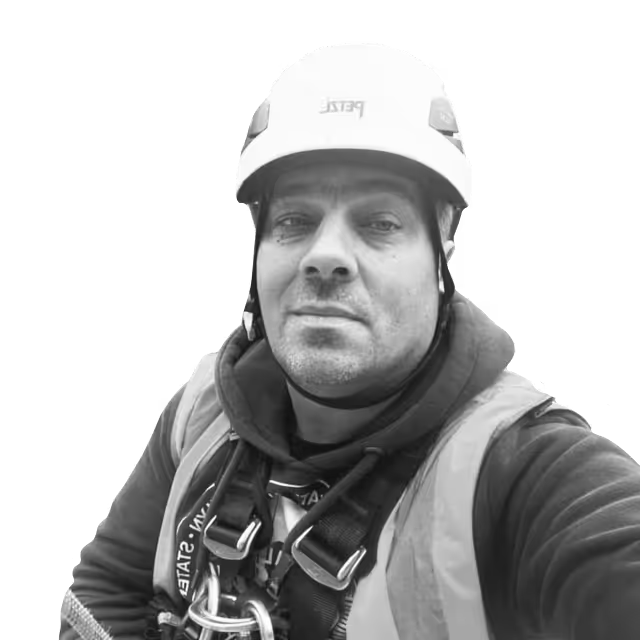
Meet Norbert, a seasoned IRATA Level 3 Supervisor with nearly 20 years' experience leading complex rope access operations
Norbert is an IRATA Level 3 Supervisor with nearly 20 years in rope access across Europe and the Middle East. He has led work on 75-storey buildings, iconic bridges, wind farms, oil and gas platforms and lighthouses. Calm, organised and resilient, he delivers safely on some of the world's most challenging sites.







Rated excellent for communication by a student accommodation client

"Good comms, great team."
Contact us about your property
Let us know which of our specialist cleaning or maintenance solutions you need.